For nonprofits and charities in Canada and the United States
Your organization qualifies for far more grants than it applies for.
TNT's Radar finds the grants. TNT's Drafter writes them. Two weeks of writing become two hours of reviewing.
A one-hour call. We build your Grant Radar before we meet, so you see your eligible grants live on the first call. No prep on your side.
Or download the one-pager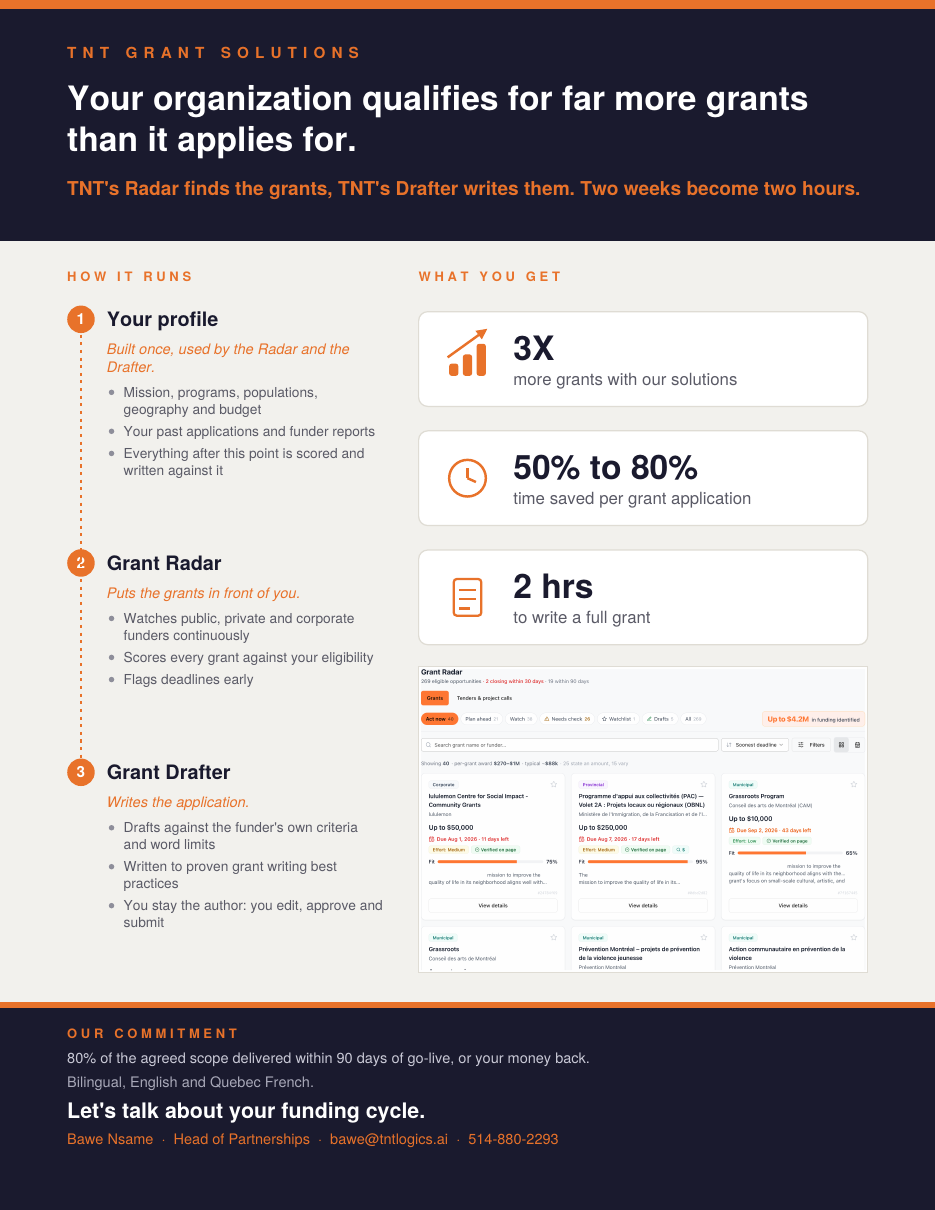
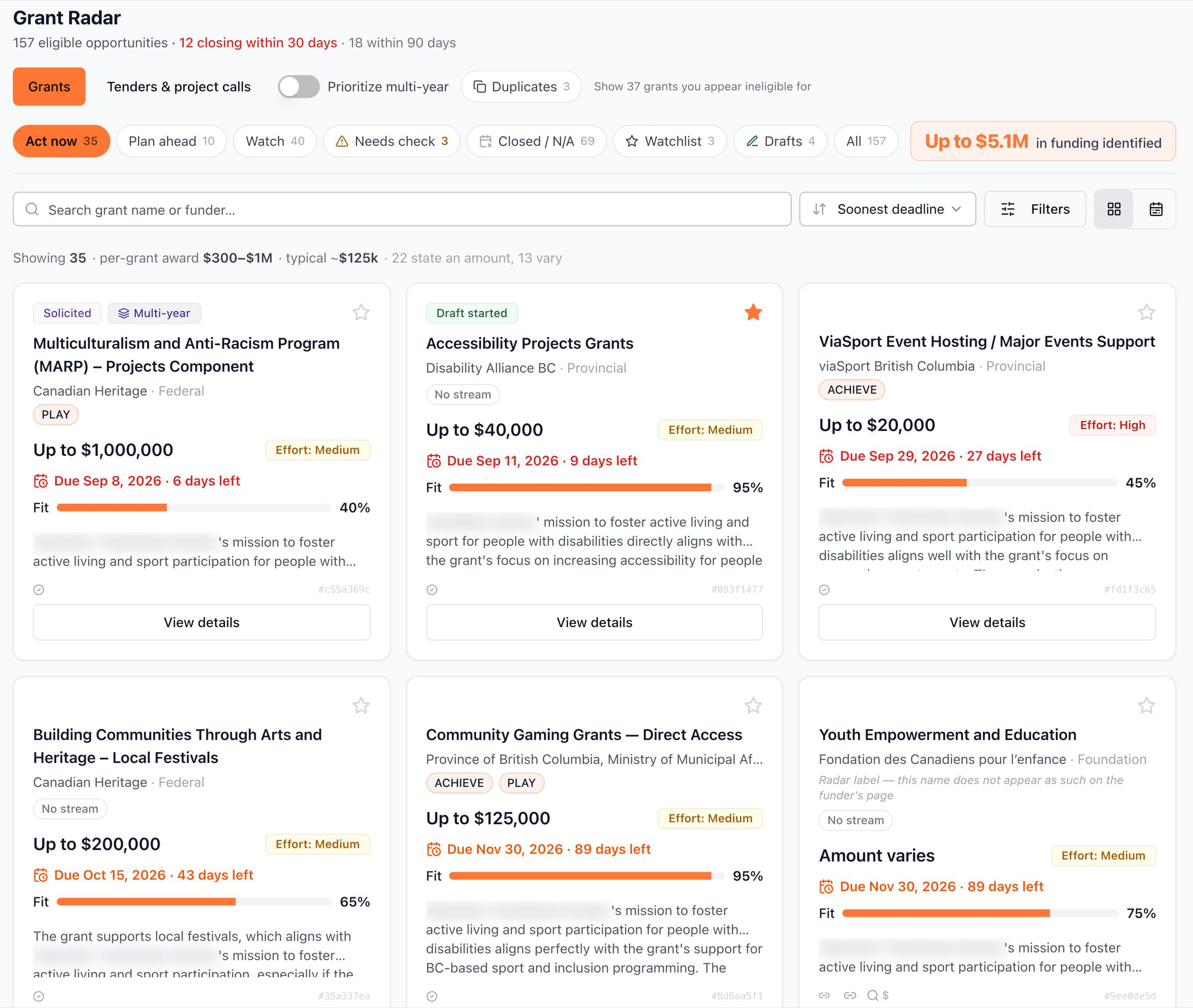
Every grant you qualify for, in one live view, scored against your organization profile.
What our clients report
more grants found with our solutions
time saved on grant discovery
time saved per grant application
to a full draft when the program already exists
Reported by organizations using Grant Radar and Grant Drafter. Results vary with program readiness and profile completeness.
Two agents. One organization profile.
We start by understanding your organization, not by listing grants. Your profile is built from public information, your own documents and a short profile interview. Everything after that is scored and written against it.
Grant Radar
Puts the right grants in front of you.
- Watches federal, state and provincial, municipal, foundation and corporate funders continuously
- Checks every eligibility criterion against your profile: 501(c)(3) or registered-charity status, geography, budget size, program type. What you clearly do not qualify for is hidden.
- Flags deadlines early, with a live countdown, and emails you a digest every week or month
Grant Drafter
Writes the application. You approve every section.
- Starts from the funder's real form, never a template
- Builds the funder brief, the strategic angle, the logic model, the budget and the narrative, one section at a time
- Runs a final review that can refuse the export until every claim has a source
Your team loses hours every week searching for grants, and two weeks for every application it writes.
Every grant-funded organization we speak with describes some version of the same four things.
Hours a week on portals
Funder sites, newsletters and forwarded links, checked by hand, every week.
Deadlines found too late
The opportunity was real. It was discovered the week after it closed.
Eligibility guessed
Dense program pages, read quickly, and a judgment call made under time pressure.
The pipeline is one person
When the person who writes the grants leaves, the deadlines and the funder relationships go with them.
None of this is a knowledge problem. It is a capacity problem.
Grant Radar
You only see the grants your organization actually qualifies for.
Federal, state and provincial, municipal, foundation and corporate sources, scanned continuously and kept as one scored list.
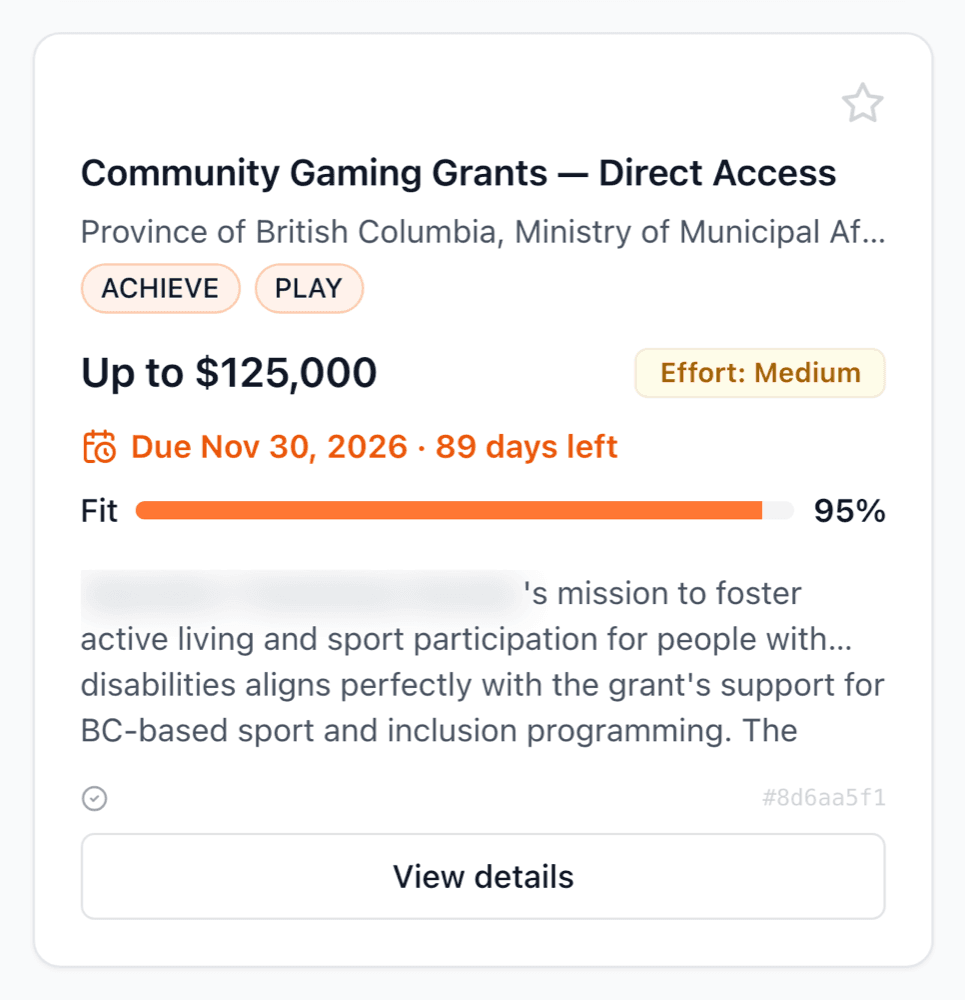
Every card tells you whether to act.
Funder type, maximum award, deadline countdown, effort estimate and fit score, all computed against your profile. Your focus shifts from "what can we apply for" to "what funds the programs we already run".
- Funder type
- Federal through corporate, so you know who you are dealing with.
- Program tags
- The programs you already run that this grant can fund.
- Maximum award
- Straight from the funder's page.
- Deadline countdown
- Turns red as it closes.
- Effort estimate
- Before anyone commits the hours.
- Fit score
- Computed against your organization profile.
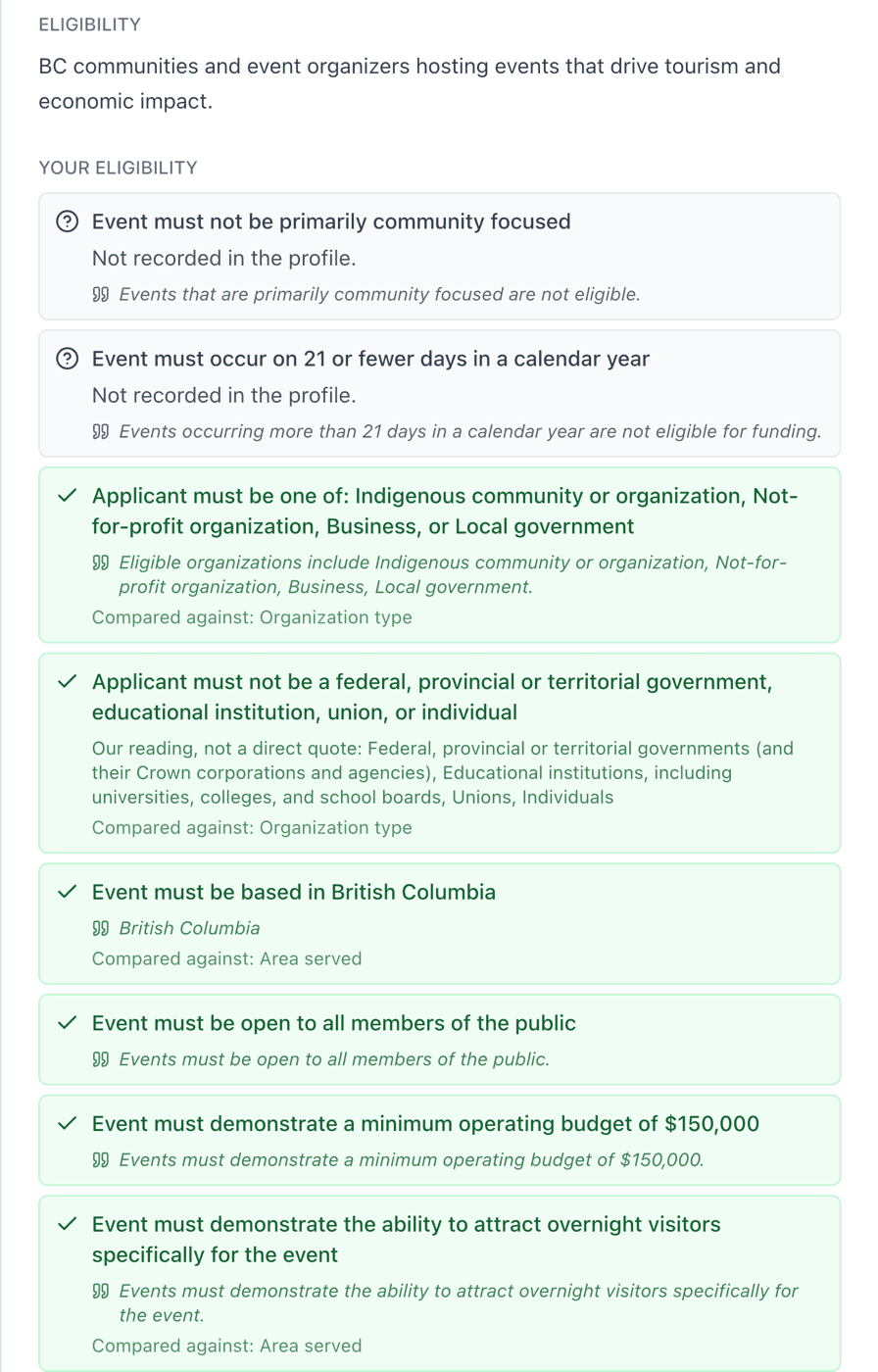
Every eligibility criterion is checked against your profile.
Green means confirmed from your own documents. Grey means not recorded, which is not the same as a no. Grants that clearly fail a hard criterion are filtered out. You can audit any recommendation before anyone commits the hours.
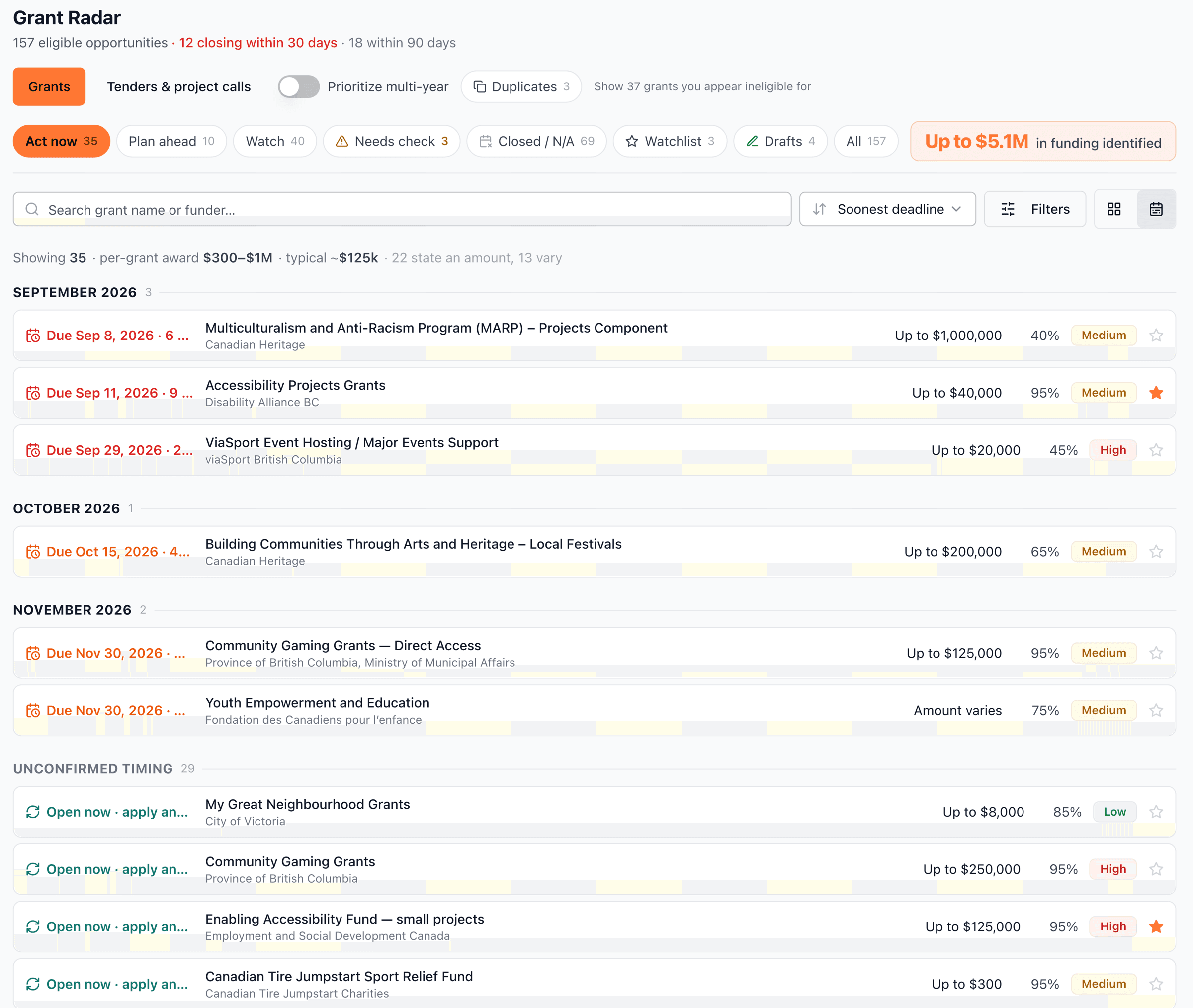
Your board sees a real grant calendar, not a spreadsheet rebuilt by hand.
One toggle turns the list into a monthly timeline. Confirmed deadlines come first with a live countdown. Open-anytime grants sit in their own group, so they never bury what is urgent.
Discovery that never sleeps.
A weekly or monthly digest brings the closing-soon grants to your inbox. Describe a new program in one sentence and Radar re-ranks every opportunity for it. Mark a grant as not a fit, say why, and the Radar learns.
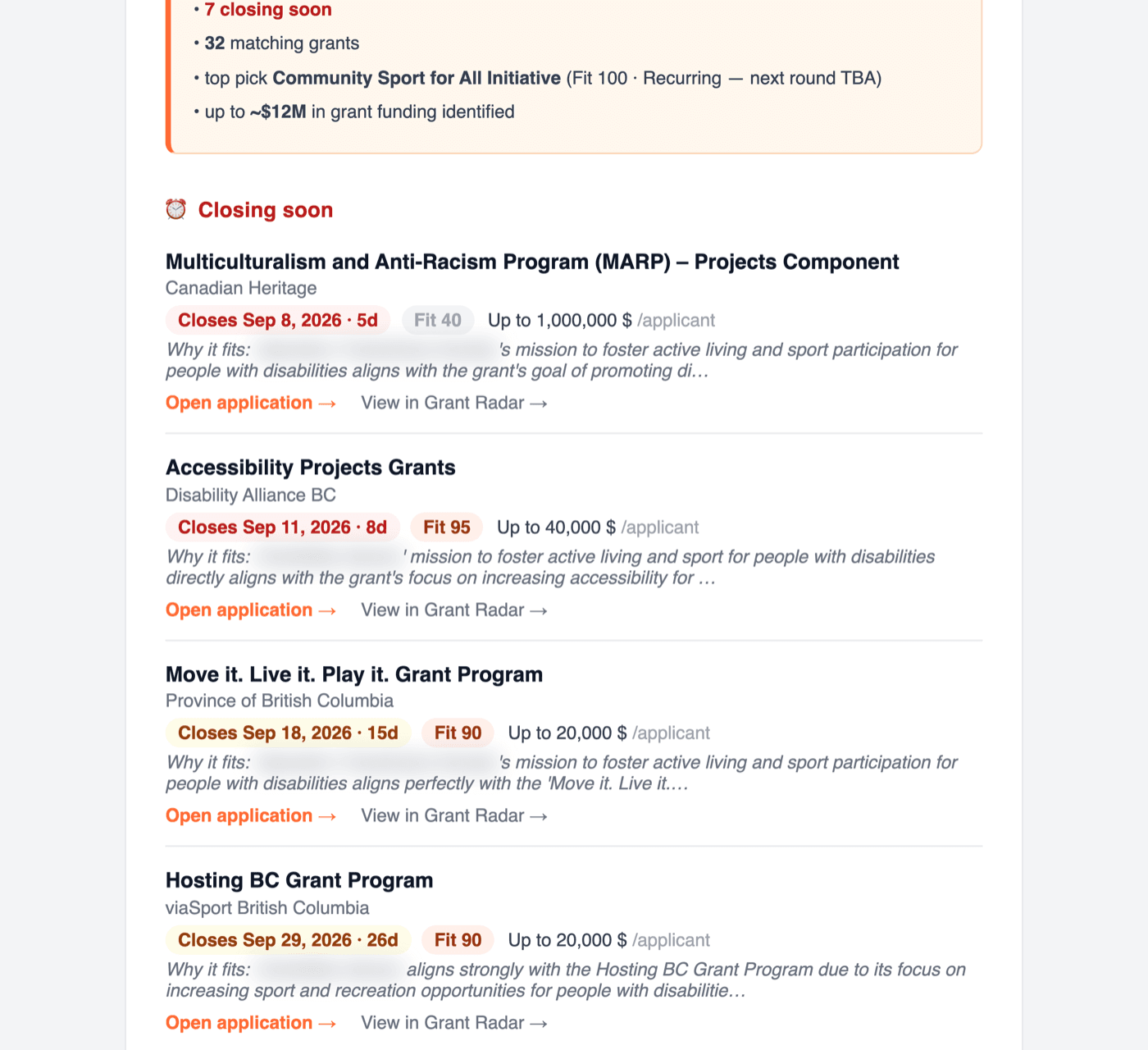
You open the dashboard knowing what to do next. Not just what exists.
A grant database hands you a list to read. Radar reads it for you: eligibility checked against your profile, fit scored, effort estimated, deadline tracked.
Grant Drafter
From opportunity to submission-ready draft, in the funder's own structure.
You talk to one chat. Behind it, four AI agents plus grant-specific software build, check and gate the work before it reaches you.
Funder deep dive
Research and alignment brief on the funder, including what they actually funded and for how much.
Strategic angle
The angles this funder rewards, proposed to you. You choose the framing.
Logic model
Inputs, activities, outputs, outcomes and impact. The framework reviewers score on.
Budget
Itemized, tied to activities, and kept under the funder's cap.
Narrative draft
Every section written in full, in the funder's structure and language.
Pre-submission review
The gate that reads it all back and can refuse the export.
Then export to Word or PDF, or copy section by section into the funder's portal.
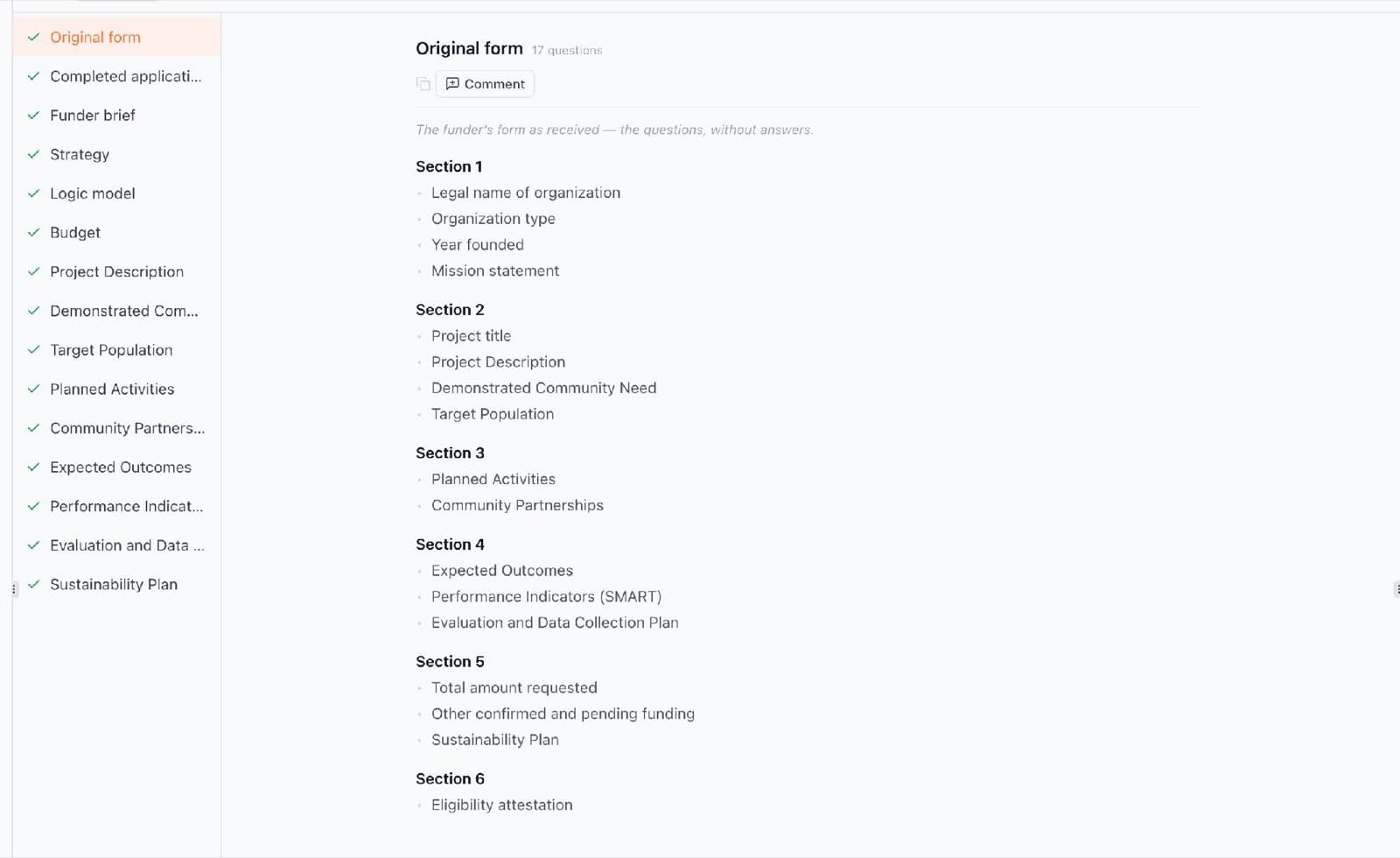
It starts from the funder's real form, never a template.
Upload the form or paste the questions in. The Drafter reads it and builds your workspace from it. Every question becomes a tracked section. This funder's 17 questions became 17 sections.
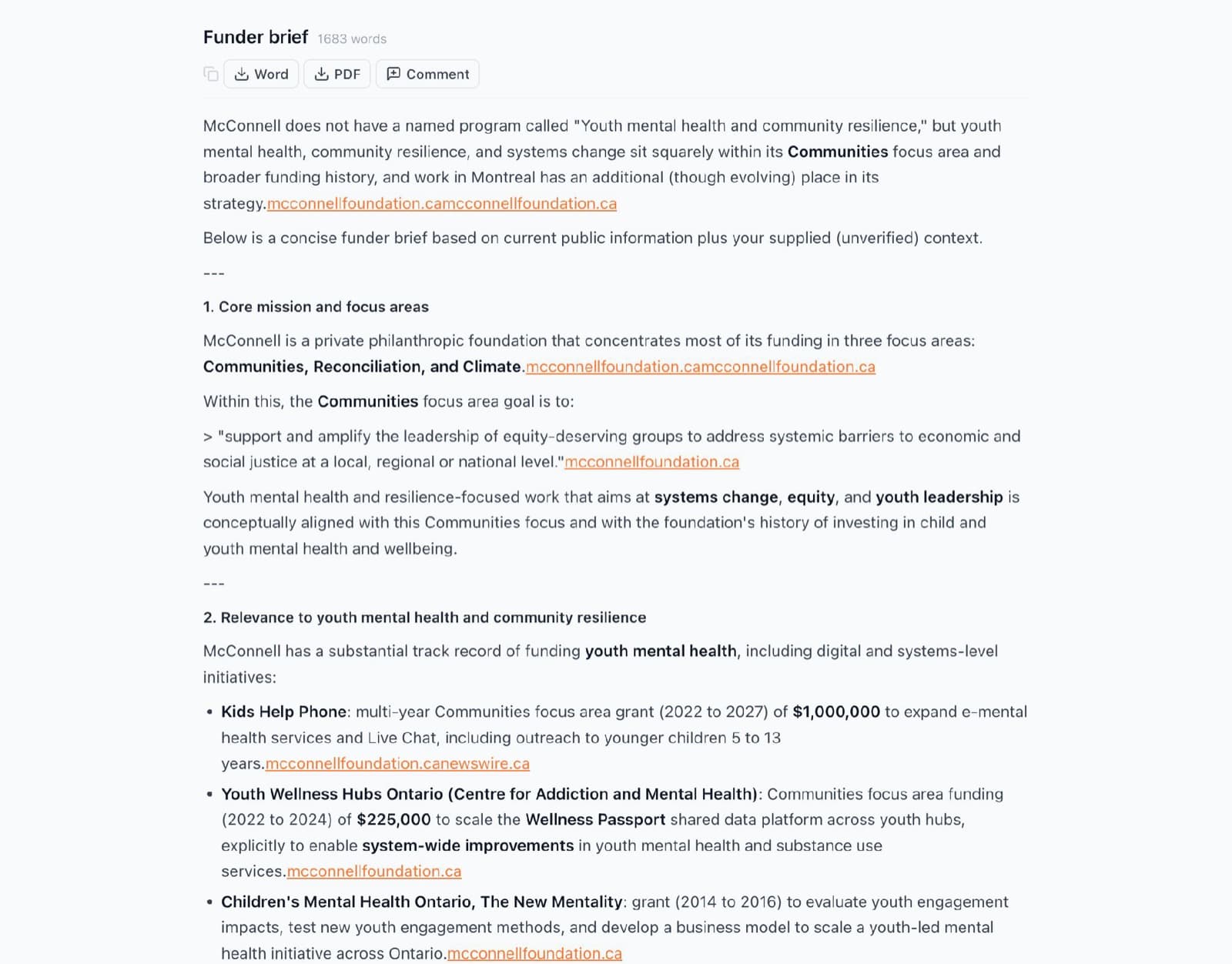
It studies the funder before writing a word.
The funder brief covers mission, focus areas and real funded precedents with amounts, drawn from public giving records (T3010 filings in Canada, IRS Form 990 in the United States). Then it proposes the angles this funder rewards. The same program can honestly chase three different pots of money. You pick one.
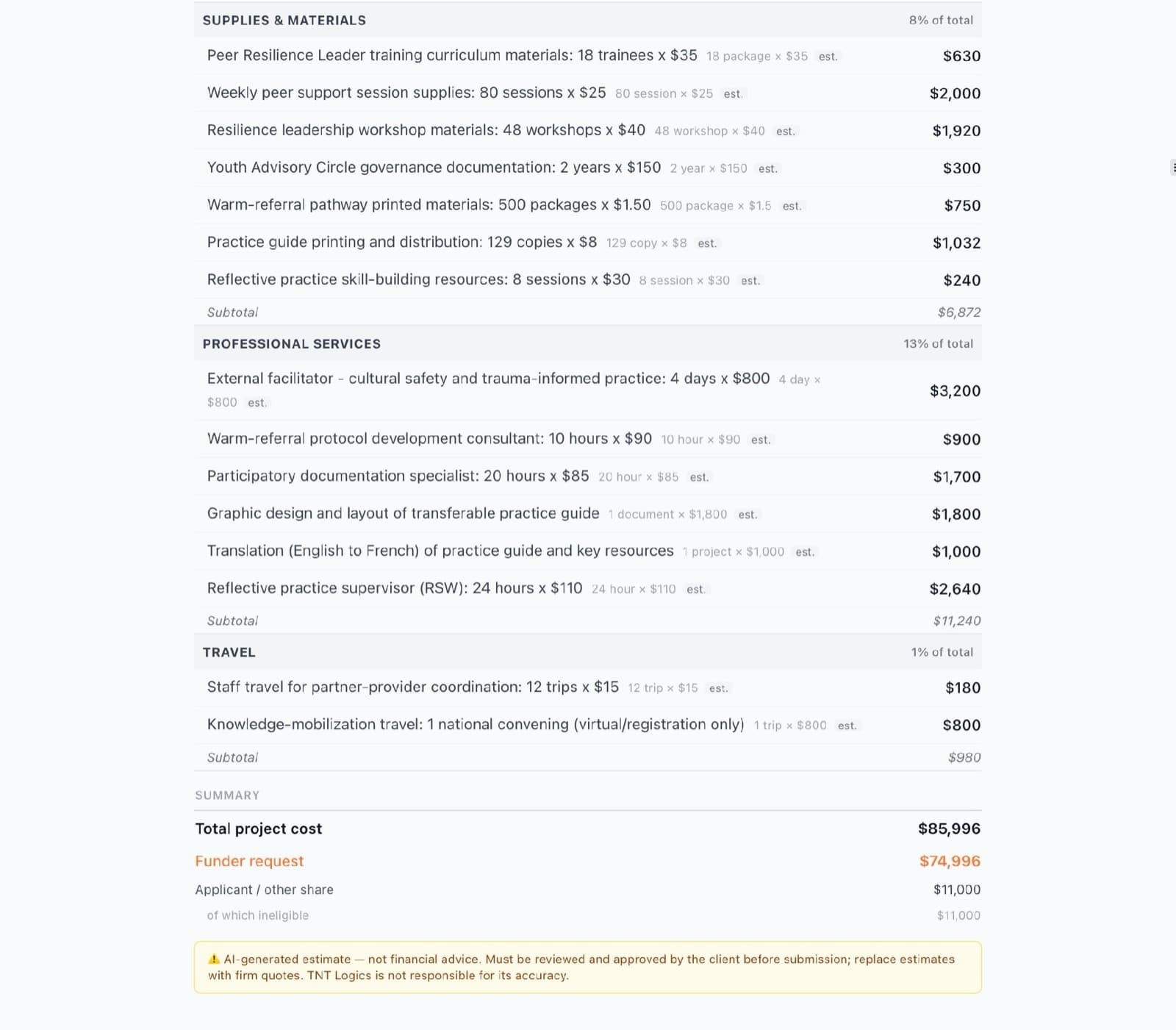
A budget that lands under the cap.
Every line shows its unit math and maps to an activity in the logic model. On this application the first pass came in at $81,242 and was trimmed to $74,996, under the funder's cap.
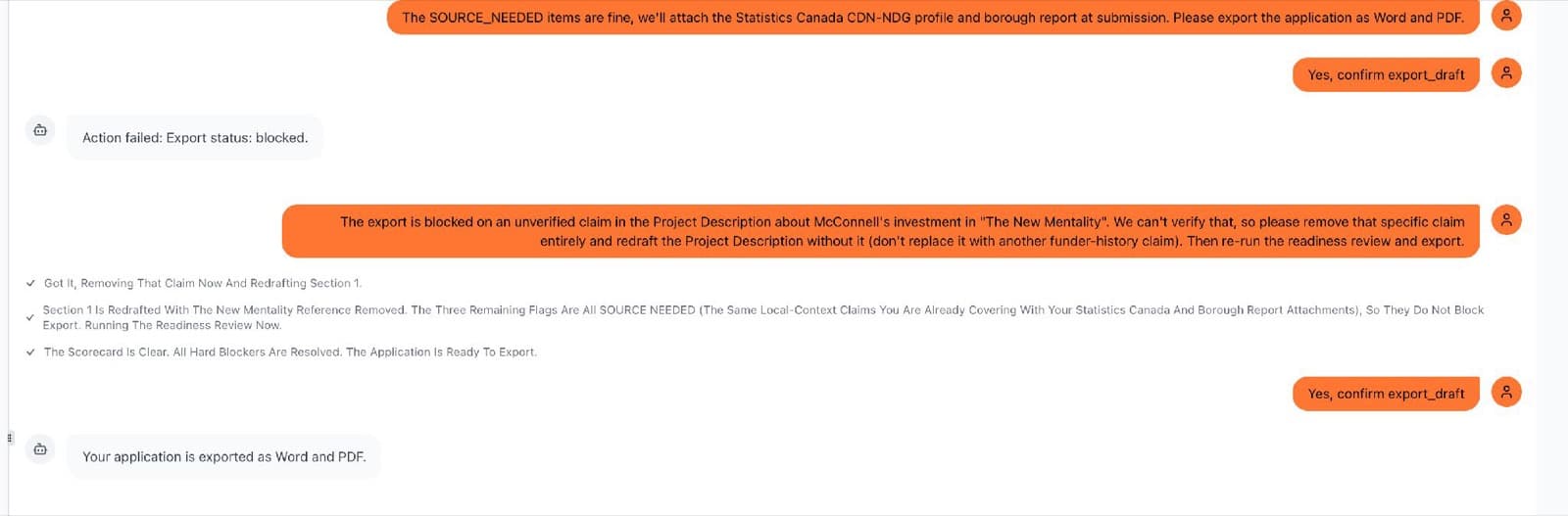
A final reviewer that can say no.
The last agent reads the finished application back against the original form and the funder brief. Here it blocked the export over a single claim we could not verify. The claim was removed, the section redrafted, the review re-run, and only then did it release the file. Expect three or four review passes per application. That is the quality bar doing its job.
Two weeks of writing becomes about two hours of reviewing, when the program already exists.
Your team stays the author.
Nothing becomes a promise to a funder without you saying so first.
Every section stays proposed until you confirm it
Targets, assumptions and claims are marked as proposed. You accept, revise or reject each one.
Every claim links back to a source
A claim in the draft points to your profile, your documents, or something you approved in the chat. If it has no source, it is flagged.
The quality gate is code, not a prompt
Unsourced facts, budget overruns and repetitive AI phrasing are caught by hard rules that cannot be sweet-talked.
It never submits for you
You export to Word or PDF, or copy section by section into the funder's portal. You attach your sources and you press submit.
English and French
Drafts, eligibility checks and digests in English or Quebec French, matched to the funder's language.
Your documents build your profile and your drafts, nothing else
We connect to where your files already live, such as Google Drive, SharePoint or OneDrive, to keep your profile current.
Three things we say plainly
- You provide the funder's application form as a PDF, a Word file, screenshots or copy-paste. There is no direct connection to funder portals.
- Some portals, municipal ones in particular, require you to register an account before the form is visible.
- Match quality depends on how complete your profile is, which is why onboarding takes about a month: kickoff, profile interview, then wiring and checks.
“You are very thorough, and you come across as incredibly honest in your approach. That is a wonderful sell.”
In their words
I'm blown away that there is a tool that can actually help us. Most of us are stuck. There is no time in the day to write grants, so we give things up.
Look at the grants available to us right now, with the timeline. I had no idea we were eligible for all of these.
One monthly subscription, no build fee.
Twelve-month term, billed monthly. Setup, onboarding and your organization profile are included.
Grant Radar
$500CAD / month
Eligible opportunities surfaced and scored against your organization profile, with deadlines tracked and a weekly or monthly digest.
See the grants you qualify forGrant Drafter
$750CAD / month
Full applications drafted section by section against the funder's own form, with the quality gate and the final review.
See the grants you qualify forBoth together
$1,250CAD / month
Discovery and drafting in one workspace. Radar finds it, Drafter writes it, one click apart.
See the grants you qualify forOur commitment
80% of the agreed scope delivered within 90 days of go-live, or your money back.
- Priced for organizations without a dedicated grant writer
- No success fee
- No percentage of grants won
- No per-seat pricing
- Feature requests welcome on Grant Drafter
What happens after you book
Two steps before you sign. Then about a month from kickoff to go-live.
You book. We build your Radar before the call.
From your organization's name and website, we build a first profile from public information and run Grant Radar before we meet.
A one-hour call on your real grants.
We present Grant Solutions end to end, then open your Grant Radar in the portal, under your organization's name, and go through the grants it found for you. We discuss your funding cycle and pricing.
You sign. Twelve months, billed monthly.
Setup, onboarding and your profile are included. Our commitment: 80% of the agreed scope within 90 days of go-live, or a refund of up to two months. Very specialized organization? Ask for a profile fine-tuning round before you sign.
Kickoff, then the profile interview.
At kickoff we decide how your documents reach us: Google Drive, SharePoint, OneDrive, or you send them. We ingest them and map the gaps. In a second meeting, the profile interview, we fill those gaps together.
Live within a month of kickoff.
One to two weeks to wire and check the profile, then you are live: Grant Radar digests in your inbox, Grant Drafter ready for your first application.
Questions we hear every time
Who is this for?
We are in the United States. Does this work for us?
How long before we are live?
How much of our time does it take?
What do you need from us?
Does it submit applications for us?
What if the AI writes something that is not true?
Can it work in French?
We do not have an AI policy yet. What happens to our data?
Is there a success fee or a percentage of grants won?
We already use a grant database. Do we still need Radar?
Can Radar search for a program we do not run yet?
What does the guarantee cover?
Your key people should serve the community. Let the Radar find the grants and the Drafter write them.
Bilingual, English and Quebec French. Serving nonprofits across Canada and the United States.
Book your call. We build your Grant Radar first.
One hour. Before we meet, we build your organization profile from public information and run the Radar, so the first thing you see is the list of grants you qualify for.
Select a date
Loading availability...
Select a date
Loading availability...